Catering (or Adapting) to Gen Z
I want to reflect openly on something I haven't yet figure out. What follows remains as an open question, its importance reflected in my ongoing thoughts and inner conflicts about it.
Students this semester (advanced students--that is, students nearing graduation) have seemed especially listless and rudderless. It is as if they are floating along in their lives. In my advanced research class, I have been impressed by the number of students who have done little or nothing, even 12 weeks into the semester. (8 out of 26 have completed half of the coursework or less as of today.) I do, however, have about 5 students who have remained engaged and have been doing well despite their peers' apparent disinterest. (I'm honestly surprised that the number of students who are behind isn't closer to 15-20! So I have blown the issue out of proportion in my mind.)
I regularly revise my courses, and I'm always looking for ways to make them more meaningful and engaging. I haven't given a traditional lecture course since my first year as an assistant professor. But even those classes ten or 11 years ago had better participation, engagement, and grades from students.
Seven years ago I made changes in an attempt to improve student (and my own) motivation. The outcome became a professor manual called Autonomy Supportive Teaching in Higher Education. I followed that with a more extreme version of autonomy support called Nondirective Teaching. Over the past few years, influenced primarily by my role as gen ed assessment coordinator, I have been making courses more focused on specifiable learning objectives. Still, I design courses from my students' perspective, I am transparent about course decisions, and I let students design aspects of the course. But little I do seems to matter. (Although, again I might be magnifying the issue somewhat.)
Gen-Z Styled Course Design?
Last night I searched for how to teach Gen Z students, hoping to learn about some aspect of curriculum design or student personality I had been missing. I found a simple article published by a university center for teaching and learning. I think it was Purdue or Indiana U. It wasn't well researched, and I suspect it was based on some assumptions about Gen Z. (I searched for an hour and was unable to find a reputable book or article about it other than this curious humor-based approach by a comedy scholar.) The gist was to design each class period around a variety of short activities to engage different parts of learners and keep them from getting bored. Get them out of their seats, interacting with each other, participating on projects or solving problems, and so on. It sounded like a lot of work, but that's my job, so I designed a rough course following that approach. It looked like this:
Gen Z Curriculum Design: Transparent (TILT framework) learning objectives and activities, engagement, short in duration.
· As I’m thinking about my research class, this would mean that every class period would have to be thought out in advance to have 4 short (15’), engaging activities (for a 75’ class) or 2-3 for a 50’ class. This includes time in-between activities, time for questions.
· Each activity would have something they’re working with or on. Something they can hold or interact with.
· Each activity would have a social component where they interact with one another.
· Each day should have a component where the instructor provides feedback.
General Activities, regardless of topic, might include:
· GRIT measures/discussion
· Self-actualization component
o Identify strengths and weannesses related to the subject
o Identify how learning goal relates to personal/career goals
· 1-2 main learning-objective-specific activities
· Discussion of main idea or ideas.
· Solve a problem (ethics, creative thinking, problem-solving)
· Read a passage and answer questions.
While taking a shower that evening, I imagined how I could rewrite an applied psychological research textbook around these sorts of activities--a thoughtful practice-based methods course that is designed specifically for Gen Z.
I went down the “cater to Gen Z students" rabbit hole on r/Professors. I was hoping to find consensus about the sorts of activities that encourage the sort of effort and interest from students that I aspire to seeing in my students. What I found, instead, is that r/Professors are not happy with the Gen Z victim mentality. While reading anecdote after anecdote, I became convinced that redesigning courses around Gen Z apathy would likely be a waste of time. One professor in particular explained how they designed the extra activities, flipped the classroom, created interactive sessions, and so on, but no matter what the professor did the students stared blankly. Even as I’m writing this, I’m imagining a classroom where students are required to bring only a notebook and pen to class so that they can answer questions to submit for attendance credit. In my imagination, half of the students forget their notebooks. And so they ask me for a notebook or paper and, later, for a pen. The resounding consensus on r/Professors, which is a comment that appears on nearly every thread, is that you have to teach to the few students who are there to learn. Still, I feel like I am failing the remaining 23 students. I feel guilty.
Reframing Guilt
Fritz Perls (Gestalt therapist) has a strategy for reframing guilt in order to work through it. He says that guilt is projected resentment. When you feel guilty, state it instead as a resentment. Once you've done that, acknowledge that people are more than what we resent about them. Do this by stating what you appreciate about them.
And so, let me flip this resentment: I feel guilty that I’m not meeting the other 23 students where they are, adapting to them so that they can grow and learn. I don’t feel guilt. I resent those students. I resent the 23 students for not giving a damn. I wish they were better and more hardworking. Now, I must acknowledge that students are more than what I resent about them. I can appreciate them, too. I am also grateful to them, because they are for me the least amount of work. They don't ask questions, they don't show me their work, and they don't submit work for me to give feedback for.
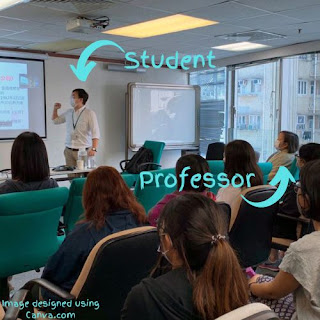
A Around half of my students attended the workshop earlier this afternoon. Six asked specific questions, and we spent nearly all 75 minutes working through those questions--satisfactorily, I think. I did not worry about the students who were missing, although a few who came in late and were scowling bothered me somewhat.
Still Unsettled
- I resent your disinterest, but I appreciate ... [I have a blockage here and can't think of how I appreciate student apathy/disinterest other than to say it means less work for me.]
- I resent your negative attitude, but I appreciate your emotional range. You are persons, after all, and dealing with emotions is part of the journey.
- I resent your disrespect, but I appreciate how I am reminded that I am just a person like the rest of you, which means that I can also be appreciated or denigrated.
Asking Students
- Focusing on personal goals and growth was helpful and the first time we’ve gotten to do it.
- Focusing on basic concepts and learning them.
- It’s hands on rather than ppt and talking.
- The didactic discussion is helpful when it happens.
- Open enough for discussion from the rest of us.
- Some of the activities were helpful (when we had to apply the various systems of psychology).
- The individual and personalized attention was helpful.
- If I know it’s not for a grade, then it feels intimate and meaningful.
- Personal discussions in the circle format was the best part.
I Asked students how they might redesign the course to be more meaningful, and they said they would design it exactly the way I had, which is letting students choose the goals and the organize the semester around those goals.
In the end, one student felt like she had narrowed in on the problem as I was experiencing it: "You just need to stop overthinking it. Go do something else that you enjoy." I think she might be right.

Comments
Post a Comment